Research Highlights
Real spaces are shaped by the people who use them. Objects are moved, stacked, and left out of place, and that clutter is a large part of what makes real scenes hard to understand and interesting to model.
Datasets and benchmarks
Indoor scenes captured in 3D and annotated with object labels.
ScanNet++
ICCV 2023 (Oral)ScanNet++ couples high-end and commodity capture of the same indoor scenes: sub-millimeter laser scans, 33-megapixel DSLR images and iPhone RGB-D video, registered to each other. Objects are annotated with free-form labels, label-ambiguous cases are marked explicitly, and the labels are mapped to fixed class sets for the benchmarks.
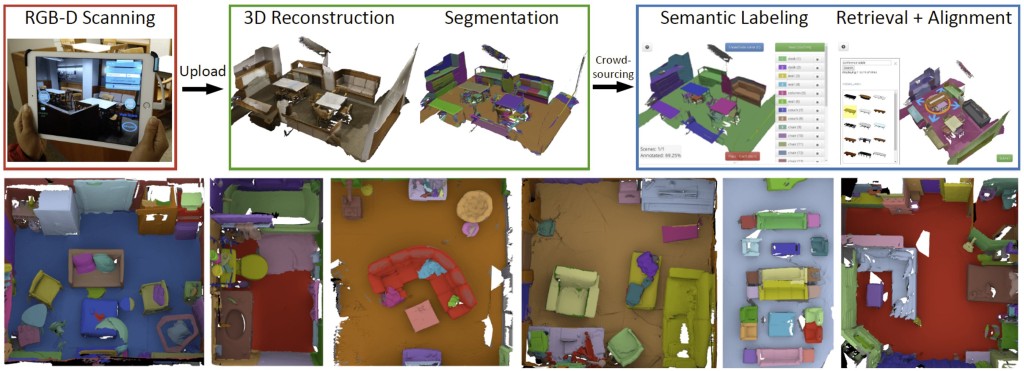
ScanNet
CVPR 2017 (Spotlight) · ScanNet200: ECCV 2022ScanNet200: D. Rozenberszki, O. Litany, A. Dai
ScanNet is an RGB-D video dataset of indoor scenes with 3D camera poses, surface reconstructions and instance-level semantic segmentations, collected with a scalable capture approach on commodity sensors and annotated through crowdsourcing. ScanNet200 extends its benchmark to the long tail of object categories found in real indoor scenes.
Perceiving interaction
Synthesizing human interaction with objects and 3D scenes, often zero-shot, and recovering how articulated objects move.
HOI-PAGE
UnfoldArt
GenZI
CG-HOI
Mesh generation
Generating meshes directly as triangles, rather than extracting dense surfaces from neural fields, gives compact meshes that work with standard graphics tools.